
Early urban archaeology in Southeast Asia: the first evidence for a Pyu habitation site at Sri Ksetra, Myanmar
Introduction
Myanmar is the largest country in mainland Southeast Asia. Since the reforms of 2011, the tempo of archaeological research has increased, and, in 2014, three Pyu cities (Sri Ksetra, Halin and Beikthano) were awarded World Heritage Site status. These cities represent early and long-lasting examples—from around the first/second–ninth centuries AD—of a type of urbanism linked with hydraulic development. Elsewhere in Southeast Asia, such cities developed later, c. the fifth–sixth centuries AD onwards. Situated in the dry zones of tropical countries, with extensive but highly uneven land-use and numerous irrigation and water-storage works, Pagan and Angkor are famous later heirs of this urban tradition.
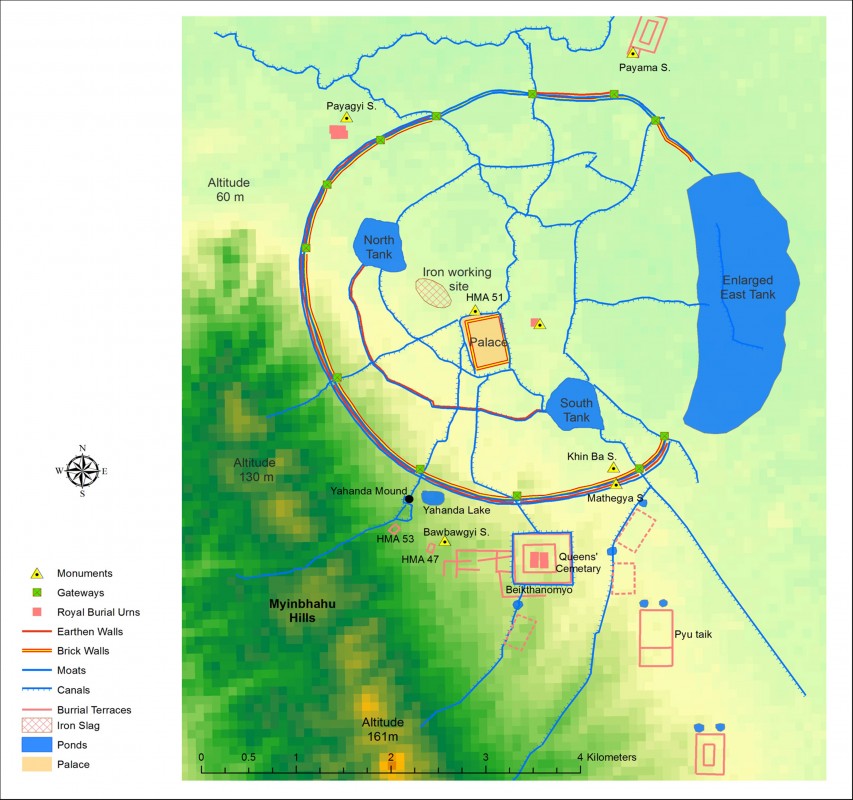
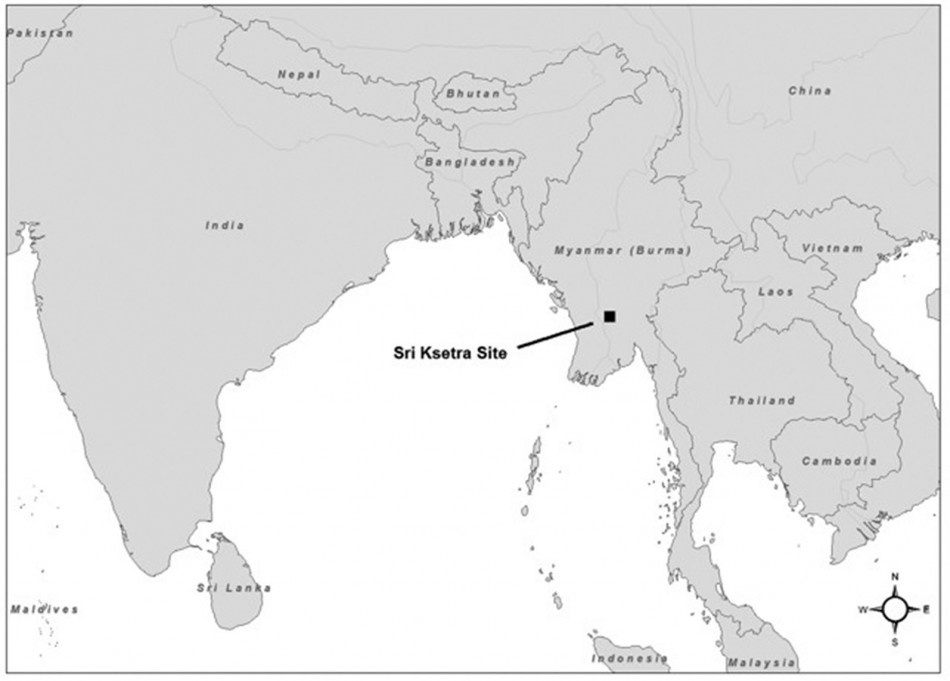
Sri Ksetra (‘Noble Field’ in Sanskrit; Figure 1) is the largest of the Pyu cities, enclosing 1857ha within its monumental brick walls, with an extramural area of a similar size. It was the largest city in Southeast Asia before Angkor, some seven centuries later. The outline chronology of Sri Ksetra rests on a small number of reliable dates acquired since 2012, augmented by styles in palaeography, iconography, architecture, Chinese records and Burmese traditional history (Hudson 2012; Stargardt 2016). Monuments, mainly of brick, surviving above ground at Sri Ksetra, comprise massive outer walls (some still approximately 5m high), a fortified inner area (‘palace’), elaborate gateways, stupas, temples, an artificial ‘cave’ and stepped terraces of rammed earth and brick containing numerous cremation burials in urns. Some 105 brick mounds have been listed inside the walls and 172 outside of that—mostly unexcavated. No Pyu habitation site has previously been found, and few are known in Myanmar as a whole.
All Pyu sites occupy niches in the vast Dry Zone of central Myanmar. During the 1980s, systems of ancient water control were traced and mapped by surface and aerial surveys at the three major Pyu cities (Stargardt 1990). Since 2006, Sri Ksetra has been progressively remapped using remote sensing and ground-truthing to identify four linked phases of water control and urban development between approximately the second century BC and the ninth century AD (Stargardt & Amable 2015; Figure 2). Excavations were undertaken between 1 January and 26 February 2015, with the primary aims of investigating the mode of habitation in a Pyu city, strengthening the objective chronology of Sri Ksetra and instigating a datable ceramic typology.
Excavations January–February 2015
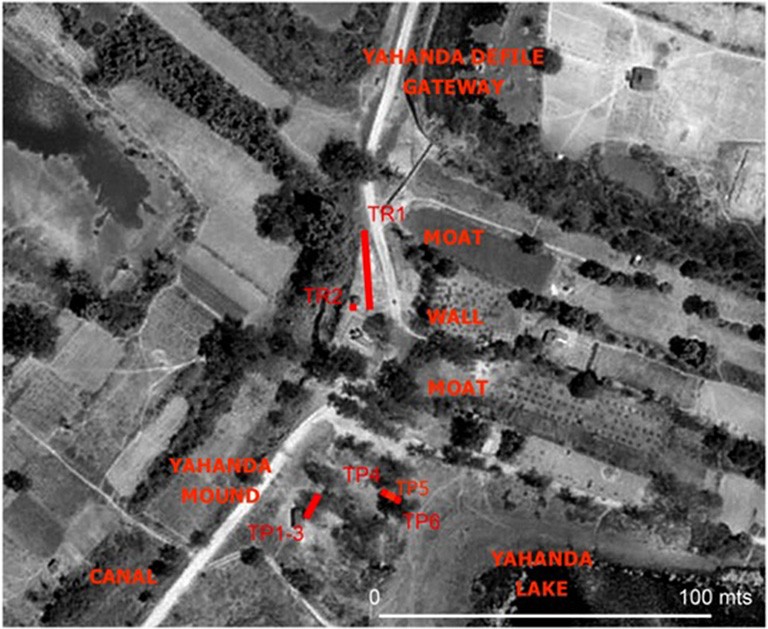
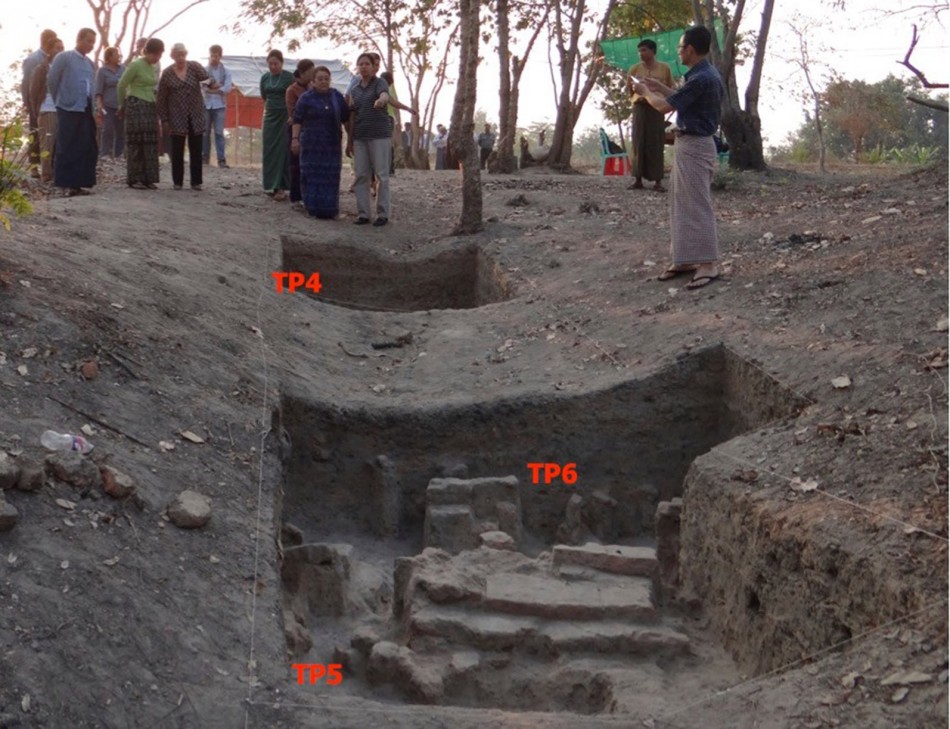
Figure 3 shows the archaeological features in the Yahanda area of Sri Ksetra, including a brick defile gateway, concentric rings of outer brick and earthen city walls, multiple moats, a canal passing the west side of the Yahanda mound, and the Yahanda Cave. This area was selected for test excavations due to promising surface finds in 2014, and because new data would strengthen an existing but undated archaeological context. Today, the Yahanda mound (HMA59, 18˚4749 N, 95˚1684 E) is deeply dissected and partly affected by heavy post-occupation erosion. It covers an area of approximately 1.6ha with its plateau at around 67m above mean sea level and around 4m above the adjacent Yahanda Lake. Six 2 × 2m test pits were excavated: HMA59 TP1–3 N/S along the mound crest, and HMA59 TP4–6 E/W down the eastern slope towards the lake (Figure 3).
The Yahanda mound crest, HMA59: test pits 1–3
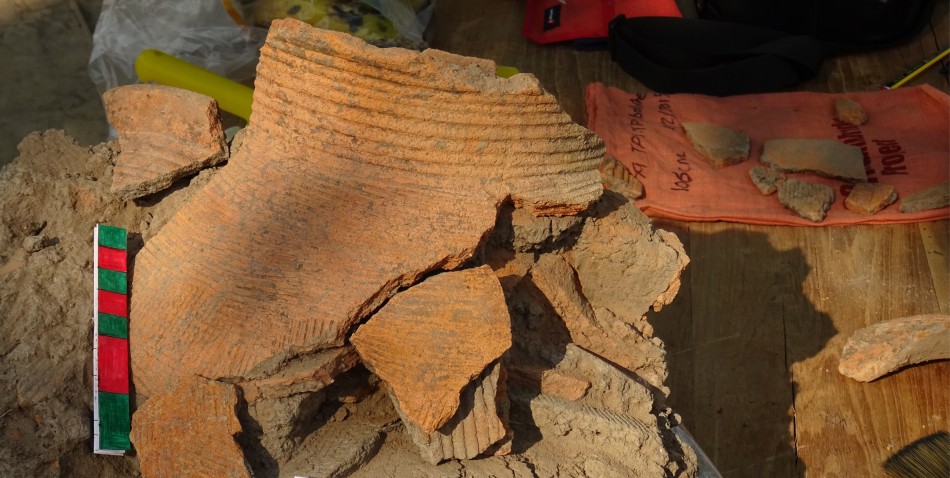
The Yahanda mound had been abandoned for a considerable period, as shown by sterile upper deposits of grey windborne silt interspersed with bands of waterborne silt and colluvial gravel. In test pit 1, however, below 50–60cm, to a depth of 230cm, 12 contexts were distinguished on the basis of geological and anthropogenic characteristics. Context 5 revealed the upper surface of an extremely hard layer extending across test pits 1–3. Locally, this was considered an impenetrable geological feature, common across Sri Ksetra. Sampling has, however, revealed a succession of thin horizontal beds made from the natural stratum of sandy silt, mixed with clay, small sherds, fine gravel and water to form a marl, spread thinly over the ground and dried by the sun. Digging confirmed it to be an anthropogenic succession of hardened surfaces, approximately 60–70cm thick in total (Figure 4), containing compacted organic matter (food spills), carbon lumps (from cooking fires), iron nails and dense concentrations of cord-marked and plain domestic pottery (Figure 5). Hardened work surfaces have so far been exposed over an area of 16m2 on the crest of the Yahanda mound.
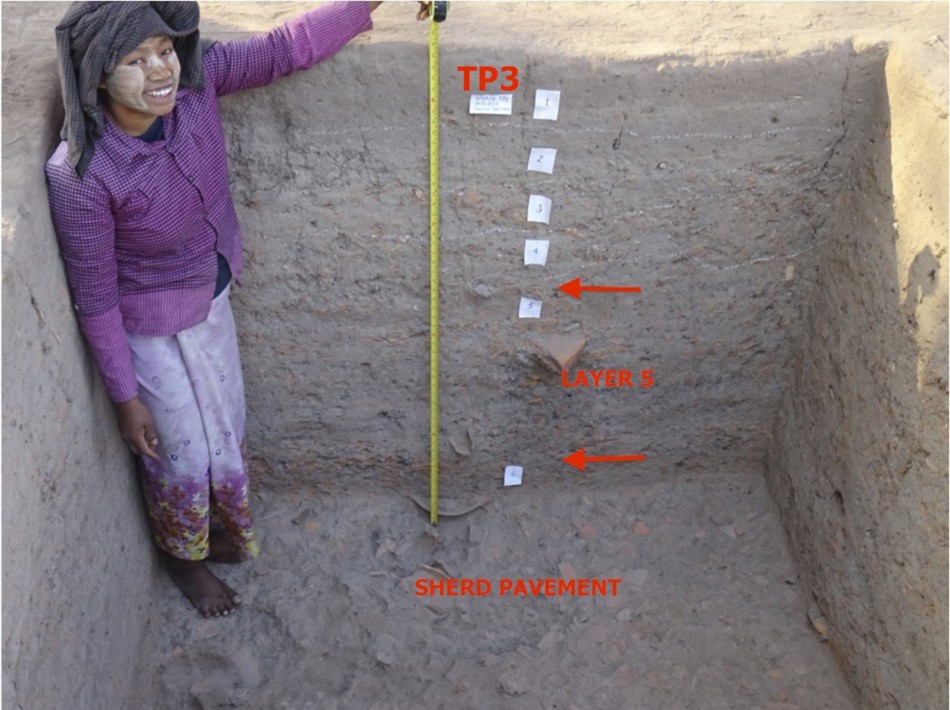
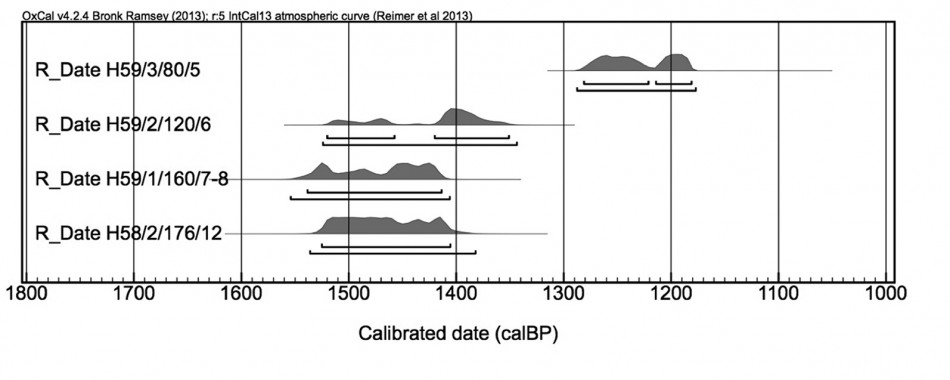
Carbon sample H59/2/120/6 in Figure 6 was taken from just below the hard surfaces, while sample H59/3/80/5 comes from about 30cm below their upper horizon. Together, these samples expose an approximately 250-year chronology of hardened work surfaces, extending from the mid-fifth into the late-seventh century AD, and probably into the eighth. The presence of iron nails throughout this habitational sequence indicated the presence of wooden structures nearby. Below the hardened work surfaces, a sherd pavement covered the entire surface of test pits 1–3 (Figure 4, contexts 5 and 6). Sample H59/1/160/7–8, taken from below them in context 7, provides an AMS benchmark at the beginning of the fifth century AD. Below it, there are five further occupational contexts, as yet undated but probably older.
The Yahanda mound, HMA59: test pits 4–6
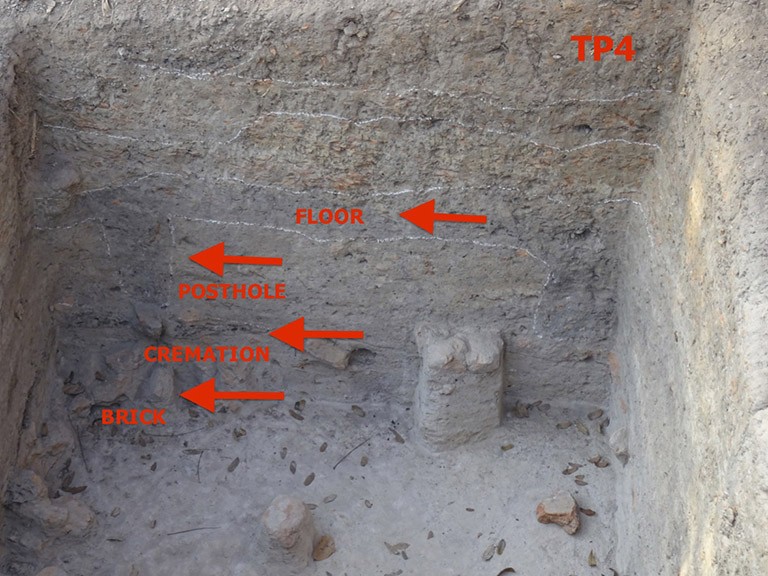
The eastern slope of the Yahanda mound was badly affected by erosion. In test pit 4 an estimated 170cm has been lost, while in test pits 5–6 an estimated 240cm was lost to erosion. Anthropogenic deposits began on and immediately below the surface, with marked contrasts in density (Figure 7). Test pit 4, context 4, was the former floor of a wooden building, with two postholes reaching into context 6. One of these postholes rested on a large cremation burial, without an urn or grave goods. Around and below this important find were the remains of a brick and earth structure. Better preserved nearby in test pits 5 and 6 were three brick steps and fragments of the brick facings (Figure 8) of a burial terrace, extending from test pits 5–6 to the cremation burial, and to associated bricks in test pit 4. The burial terrace was thus located directly under the postholes, while four habitation layers (out of a probable longer habitation sequence now lost to erosion) survived above the wooden floor.
Conclusions
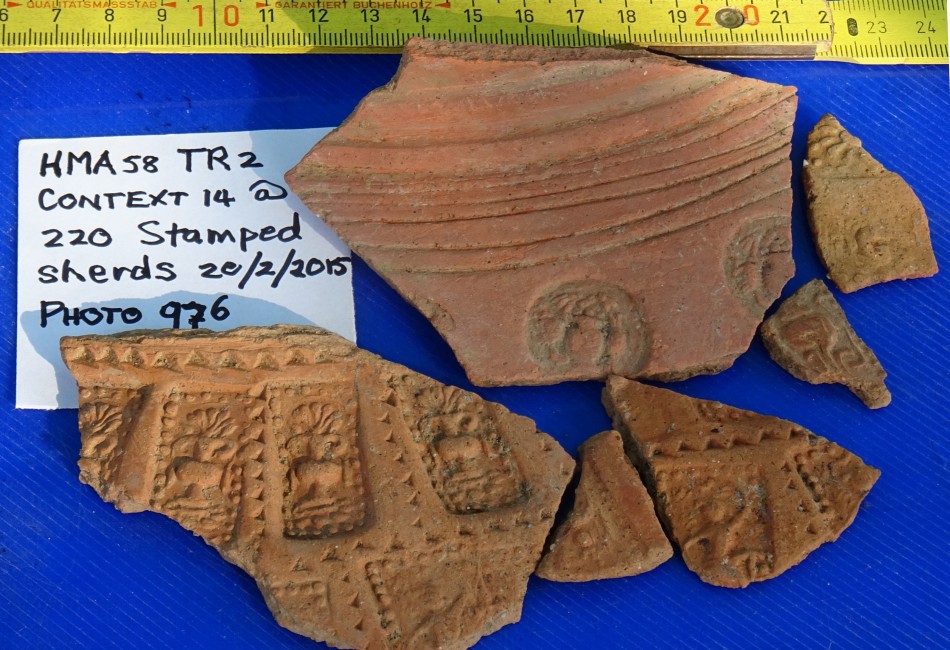
Sample H59/2/120/6 in Figure 6 agrees in part with fifth- to seventh-century AD AMS dates obtained from two burial terraces nearby (which may in fact have much earlier origins), but it has much clearer associations (cf. Hudson 2012; Stargardt in press). Dates for contexts 8–12 in test pit 1 are not yet available, but sample H59/1/160/7-8 already sets a benchmark for context 7 at the beginning of the fifth century AD; contexts 8–12 underlie it and can be presumed to be earlier. Domestic cord-marked wares continued there, but major new ceramic types appeared: finely incised, rouletted and stamped ceramics with sacred Buddhist-Hindu motifs (Figure 9), which reflect contacts with Indic religions and ceramic decorative techniques. Preliminary tests indicate that they were made from local clays (Sean Taylor pers. comm.) to be confirmed). Similar ceramics appeared in sixth or post-sixth century AD contexts in some Dvaravati sites of Central Thailand and were thought to have been introduced by Indian potters (Indrawooth 2009: 39). Yahanda research will illuminate the origins and date of these important ceramics.
The earliest habitation layer exposed so far at the Yahanda mound (in test pits 4–6) is pre-fifth century AD and rested on a cremation burial found in the remnants of a burial terrace. One example does not prove that the posthole of an early dwelling was deliberately sunk to touch the cremation burial. But the existence of the burial terrace directly under the house suggests that this was probably a deliberate choice. Grouped cremation burials have previously been found at Sri Ksetra surrounding Buddhist stupas of c. fifth–seventh century date and in burial terraces of c. sixth–seventh century date. The discoveries at the Yahanda mound may offer glimpses of the presence of the dead under a Pyu house before the fifth century AD, as with the approximately contemporary residential burials found in late Iron Age contexts at Ban Non Jak, north-east Thailand (Higham 2015).
The Yahanda mound excavations have revealed the first, long habitational sequence of any period exposed in Myanmar, demonstrating significant phases of change and producing reliable, scientific dates. The time-span shown in Figure 6 confirms stylistic indications that the fifth/sixth–eighth centuries AD were a flourishing period in late Pyu culture at Sri Ksetra. H58/3/80/5 is at present the only reliable date for the Pyu in the late first millennium AD from any site in Myanmar. Hardened work surfaces, identified and dated here for the first time, will be diagnostic indicators of other habitation sites in this city and perhaps elsewhere. The first outline stratigraphy, typology and chronology of ceramics and iron at Sri Ksetra has begun. Previously, pre-fifth century AD evidence for Indic-inspired religion and literacy in Southeast Asia was rare, isolated and stylistic: the palaeography of a few inscriptions in Vietnam, Java and Borneo. The Yahanda excavations provide objective dates for the appearance at Sri Ksetra of Indic religions before the fifth century AD and do so in the context of habitational activities. They begin not only to fill a gap in Myanmar archaeology, but also to respond to regional questions of trade, cultural change and urbanism in early first millennium Southeast Asia, for which other evidence is sparse indeed.
Acknowledgements
Excavations began at the invitation of the Director-General, Myanmar Department of Archaeology and Museums, with permission from the Minister and Deputy Minister of Culture, and were conducted as a cooperative project between the Field School of Archaeology, Pyay, and the University of Cambridge. Surveys from October–November 2014 were supported by the McDonald Institute of Archaeological Research and Sidney Sussex College, University of Cambridge; excavations from January–February 2015 were supported by the ERC Synergy Grant 609823 ASIA.
References
- FALLON, S.J., L.K. FIFIELD & J.K. CHAPPELL. 2010. The next chapter in radiocarbon dating at the Australian National University: status report on the single stage AMS. Nuclear Instruments and Methods in Physics Research B268: 898–901. http://dx.doi.org/10.1016/j.nimb.2009.10.059
- HIGHAM, C.H. 2015. From site formation to social structure in prehistoric Thailand. Journal of Field Archaeology 40: 383–96. http://dx.doi.org/10.1179/2042458214Y.0000000010
- HUDSON, B. 2012. A thousand years before Pagan. Radiocarbon dates and Myanmar’s ancient cities’ (Conference on early Myanmar and its global connections, Pagan, February 2012). Available at: https://www.academia.edu/5489143/Hudson_Bob_2012_A_Thousand_Years_Before... (accessed 19 November 2015). .
- INDRAWOOTH, P. 2009. Un antique royaume urbanisé de Thailande, in Pierre Baptiste & Thierry Zephir (ed.) Dvaravati; aux sources du bouddhisme en Thailande: 31–45. Paris: Musée Guimet.
- STARGARDT, J. 1990. The ancient Pyu of Burma. Volume 1: early Pyu cities in a man-made landscape. Cambridge & Singapore: PACSEA & ISEAS.
- – 2016. From the Iron Age to early city at Sri Ksetra and Beikthano, Burma [Myanmar], in Stephen Murphy & Miriam Stark (ed.) Transitions from late prehistory to early historic periods in mainland Southeast Asia, ca. early to mid-first millennium CE Journal of Southeast Asian Studies (Special issue).
- STARGARDT, J. & G. AMABLE. 2015. Water in the ancient city: a new method of satellite surveys of irrigation works at Sri Ksetra, Burma, in Noel Hidalgo Tan (ed.) Advancing Southeast Asian Archaeology 2013: 144–52 & 184–87. Bangkok: SEAMEO SPAFA, Regional Centre for Archaeology and Fine Arts.
Authors
* Author for correspondence.
- Janice Stargardt*
Sidney Sussex College and McDonald Institute, University of Cambridge, Sidney Street, Cambridge CB2 3HU, UK (Email: js119@cam.ac.uk) - Gabriel Amable
Department of Geography, University of Cambridge, Downing Place, Cambridge CB2 3EN, UK - Sheila Kohring
Materiality Laboratory, McDonald Institute, University of Cambridge, Downing Street, Cambridge CB2 3DZ, UK - Sean Taylor
McBurney Laboratory, Archaeology Division, University of Cambridge, Downing Street, Cambridge CB2 3DZ, UK - Stewart Fallon
Radiocarbon Laboratory, Research School of Earth Sciences, Australian National University, 1 Mills Road, Building 142, Canberra A.C.T. 2601, Australia - Win Kyaing
Field School of Archaeology, Department of Archaeology and Museums, Pyay, Myanmar - Tin May Oo
Field School of Archaeology, Department of Archaeology and Museums, Pyay, Myanmar - Tin Tin Htay
Field School of Archaeology, Department of Archaeology and Museums, Pyay, Myanmar - Kyaw Myint Oo
Field School of Archaeology, Department of Archaeology and Museums, Pyay, Myanmar - Nyo Nyo Yin Mauk
Field School of Archaeology, Department of Archaeology and Museums, Pyay, Myanmar - Naw Poe Wah
Field School of Archaeology, Department of Archaeology and Museums, Pyay, Myanmar - Win Sein
Field School of Archaeology, Department of Archaeology and Museums, Pyay, Myanmar
 Cite this article